
Investment Casting (Lost-Wax Casting) Simulation: Predict and Prevent Misruns and Shrinkage Cavities Before Trial Pouring
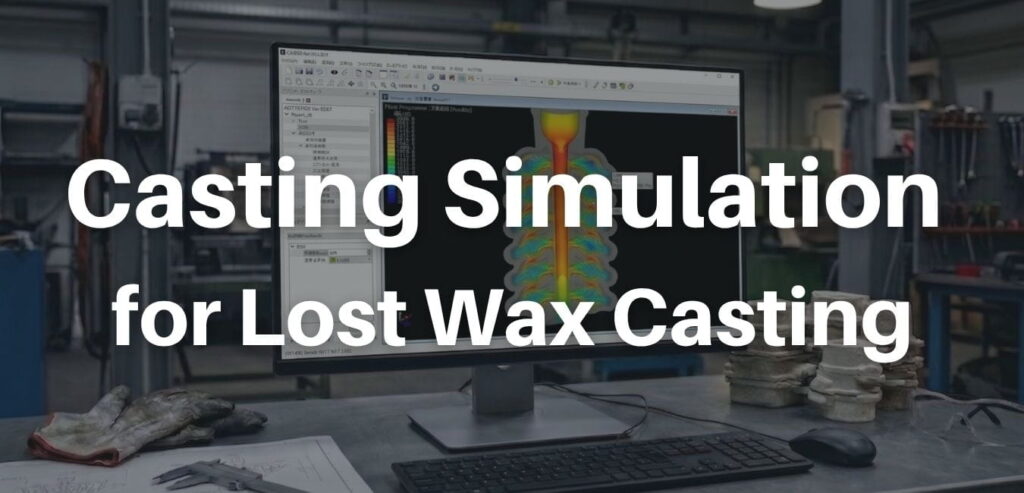
Investment casting (lost-wax casting) is an excellent casting process capable of integrally forming complex shapes, thin-walled structures, and high-precision metal parts. However, the long lead times and high cost of its manufacturing process pose significant challenges that trouble many engineers and executives.
From mold design and fabrication to wax pattern injection, tree assembly, ceramic shell coating and dewaxing, firing, and pouring of the molten metal—just conducting a single trial requires a tremendous amount of time and prototyping costs.
What if it were possible to accurately predict the occurrence of misruns and cold shuts, or internal shrinkage cavities prior to performing the actual trial pouring?
The Limitations of a Trial Cycle Relying on On-Site Intuition and Experience
In the lost-wax casting process, insufficient flow (misrun) caused by a temperature drop of the molten metal in thin-walled sections, or directional solidification failure due to improper design of runners and gates, directly leads to an immediate increase in the defect rate.
- Repeated Trial and Error: Every time a misrun or shrinkage cavity is found in a prototype casting, the gating system must be modified, the wax mold revised, and the ceramic shell rebuilt to conduct another trial pouring.
- Deterioration of Yield: As a result of providing excessive risers and gating systems to prevent shrinkage cavities, the yield decreases, putting pressure on manufacturing costs.
- Delivery Delays: As the number of trials increases, the lead time extends, allowing competitors to seize opportunities.
“Is it impossible to pour a defect-free casting right from the first trial?” The solution lies in casting CAE simulation, which accurately visualizes casting phenomena on a computer.
Pre-Trial Visualization Brought by ADSTEFAN
The casting simulation system “ADSTEFAN” was developed based on the research results of industry-academia collaboration led by Tohoku University, and is widely applicable to various casting processes, including lost-wax / investment casting. Beyond being a mere defect prediction tool, it can be utilized as a “powerful proposal tool” to present technical evidence of quality to clients (OEMs and Tier 1 customers) and secure new projects with confidence.
| Fluid Flow Analysis (Fluid Flow Analysis) |
Visualizes the filling behavior of the molten metal, temperature drop until filling completion, and flow collisions. It identifies high-risk areas for the occurrence of misruns and cold shuts, as well as air and slag entrainment. |
|---|---|
| Solidification Analysis (Solidification Analysis) |
Accurately tracks temperature gradients and solidification progression times within the casting. It identifies the final solidification areas (hot spots) and quantitatively evaluates the location and size of shrinkage cavities and micro porosity. |
1. Preventing Misruns Proactively with Fluid Flow Analysis
In thin-walled and complex investment castings, “misruns,” where the molten metal injected into the shell mold solidifies before completely filling the cavity, occur frequently. By utilizing the Fluid Flow Analysis of ADSTEFAN, the velocity of the fluid flow, temperature changes, and the timing of insufficient flow can be accurately predicted. The optimization of pouring temperature, pouring speed, and gate positions can be instantly verified for multiple patterns on a computer.
2. Achieving Optimal Riser and Gating Design through Solidification Analysis
“Shrinkage cavities,” caused by solidification shrinkage when the molten metal cools and solidifies, are defects that cannot be discovered without X-ray CT inspection or destructive testing. ADSTEFAN’s Solidification Analysis visualizes the risk of internal defect occurrence by utilizing advanced calculation methods such as evaluation of soundness and the Niyama criterion. Since appropriate risers can be placed only in necessary areas, it achieves both quality improvement and yield enhancement of the product.
High-Speed and Easy Analysis on a Single PC without Specialized Knowledge
There is no need for concerns such as “Simulation software seems difficult to implement and operate” or “Will it take days to get analysis results?” ADSTEFAN is designed to be easily utilized by on-site engineers.
- Direct Import of 3D CAD (STL Data): Even complex shell mold and tree shape data can be quickly modeled for analysis using an intuitive automatic mesh generation function.
- Overwhelming Analysis Speed: Supporting massively parallel processing (MPI) and GPU computing (GPGPU), calculations are completed in a short time. This enables rapid cycles of trial and error.
- Extensive Material Database: A wide variety of physical property data used in investment casting, such as various stainless steels, heat-resistant alloys, aluminum alloys, and copper alloys, is equipped as standard.
- Standardization of Know-How and Prevention of Individualization: Breaking away from designs relying solely on the “intuition and experience” of veteran engineers. By accumulating simulation results as a common digital asset for the company, a strong technical foundation can be built that is not affected by the risk of personnel turnover.
Why Not Start with an Annual License?
To truly experience the return on investment (ROI) from implementing simulations, verifying its prediction accuracy with actual on-site products is the best approach.
For ADSTEFAN, which boasts a large number of implementations in investment casting (lost-wax casting) sites in Thailand, an annual license is available to lower the barrier for initial implementation.
- Extensive Track Record in Thailand: A casting simulation software proven in investment casting (lost-wax casting) sites in Thailand.
- Rapid Payback through Prototype Reduction: The annual license fee is easily offset by the cost savings achieved from reducing physical trial pourings.
- Comprehensive Local Support: A multilingual technical support platform including Thai, along with hands-on operational training.
- Capitalization of Know-How: Reliably accumulating the company’s gating design know-how as internal digital assets.
From casting based on “intuition and experience” to “logical casting with confidence.”
Before the trial pouring, why not start a new simulation operation with ADSTEFAN for one year?
Inquiry and Document Request Information
Inquiries regarding benchmark analysis tests using 3D models of your own products and license pricing plans are always welcome. Please feel free to contact us.

Casting Analysis Product