
A Guide to X-ray CT Inspection Equipment Possession and Radiation Safety Officer (RSO) Regulations in Thailand
This guide explains Thailand’s current laws regarding radiation generator possession, how to identify if your X-ray CT inspection equipment qualifies for regulatory exemption from appointing a Radiation Safety Officer (RSO), and step-by-step processes for compliant registration.
1. Relevant Laws and Owner Responsibilities
The possession and use of radiation generators (X-ray inspection equipments) in Thailand are strictly governed by the Nuclear Energy for Peace Act B.E. 2016 and its B.E. 2019 Amendment. These official legal structures are meticulously designed to safeguard plant personnel, public health, and the environment from unnecessary radiation hazards.
Previously, under Section 92 of the B.E. 2016 Act, any person who was a licensee or notified the possession/use of a radiation generator was legally bound to appoint at least one Radiation Safety Officer (RSO) to supervise safety operations on the premises.
The 2019 amendment significantly streamlined these guidelines to reduce unnecessary administrative burdens on organizations utilizing high-safety, shielded systems. The licensing framework transitioned key equipment categories from a strict ‘Licensing’ model to a streamlined ‘Notification of Possession’ system instead. Consequently, many general industrial operations in Thailand today are no longer legally required to designate a formal RSO.
For complete legal texts, you can explore the official publications at the Royal Thai Government Gazette Portal (ratchakitcha.soc.go.th) or check detailed enforcement summaries on the Office of Atoms for Peace (OAP) Thailand Website.
2. Quick Check: Does Your X-ray CT Scanner Require an RSO?
For operators deploying industrial X-ray CT scanners, a dedicated Radiation Safety Officer is not required if your machinery satisfies specific built-in security conditions. Use the checklist below to assess your current installation:
| Quick Check Criteria | Condition for RSO Exemption | Exempt from RSO |
|---|---|---|
| Maximum X-ray CT Inspection System Energy | Maximum X-ray generator output is below 1 MeV or 1 MeV. |
|
| Cabinet & Shielding Design | The system features a fully shielded cabinet and is designed exclusively for industrial inspection (not for biological/human scanning). |
|
| Regulatory Group Classification | Belongs to the Notification of Possession or Use group. You can download the official notification of possession application forms via the OAP X-ray Licensing and Notification Resource Hub. |
|
3. The 4 Categories of Radiation Generators
The following table summarizes equipment classification based on risk and the relevant RSO requirements. You can find more details regarding generator categories in our previous article to help you appropriately allocate RSO personnel:[NDT] 2025 Updated Guide for the Registration of X-ray CT Inspection System (Radiation Generator) in Thailand
| Radiation Generator Category | Risk Level | Example Equipment | RSO Requirement |
|---|---|---|---|
|
Category 1 Permit Required |
Very High | Generators operating at maximum radiation energies of 1 MeV or higher. | Mandatory (Advanced Level RSO) |
|
Category 2 Permit Required |
High | High-energy industrial X-ray systems operating between 5 kV and 1 MV, or greater than 5 keV but less than 1 MeV. | Mandatory (Intermediate Level or higher) |
|
Category 3 Notification of Possession must be submitted within 30 days |
Moderate | Shielded X-ray CT scanners (not for human) or closed-cabinet NDT testing apparatus operating between 5 kV and 1 MV, or greater than 5 keV but less than 1 MeV. | Not Required (Qualifies for Notification) |
|
Category 4 Ready for use by strictly adhering to the ALARA Principle |
Low | Compact, self-contained X-ray inspection devices with robust built-in shielding and energies not exceeding 5 kV or 5 keV. | Not Required |
4. Understanding the RSO and Levels of Expertise
Although current ministerial regulations no longer require an RSO (Radiation Safety Officer) in all facilities, especially for low-risk radiation generators that use a Notification of Possession or Use system instead of a license and there still can be at least an RSO (Radiation Safety Officer) at the basic level to ensure the safety of the radiation facility. For establishments with high-risk radiation generators or those wishing to appoint an RSO to oversee safety standards within the organization, selecting personnel with the appropriate level of knowledge is still very important.
According to the Ministerial Regulation B.E. 2020, certified RSO personnel are structured across three distinct expertise profiles. If you decide to appoint or train internal personnel, ensure they target the correct qualification tier:
| RSO Professional Certification Tier | Category 1 | Category 2 | Category 3 | Category 4 | |||
|---|---|---|---|---|---|---|---|
| For sale | For security safety or security protection | General Use | For sale | General Use | (Qualifies for notification) | ||
| Advanced Level (Designed for Machine Cat 1 & 2) |
– | ✔ | ✔ | ✔ | ✔ | ✔ | ✔ |
| Intermediate Level (Designed for Machine Cat 1 & 2) |
– | ✔ | ✔ | ✔ | ✔ | ✔ | ✔ |
| Basic Level (For machine that require notification of possession sale & Import/Export) |
✔ | – | – | ✔ | – | ✔ | ✔ |
| Exempt / No RSO Required (Legal Exemption via B.E. 2019) |
– | – | – | – | – | ✔ | ✔ |
5. Registration Procedures to be an RSO Officer and Required Documents
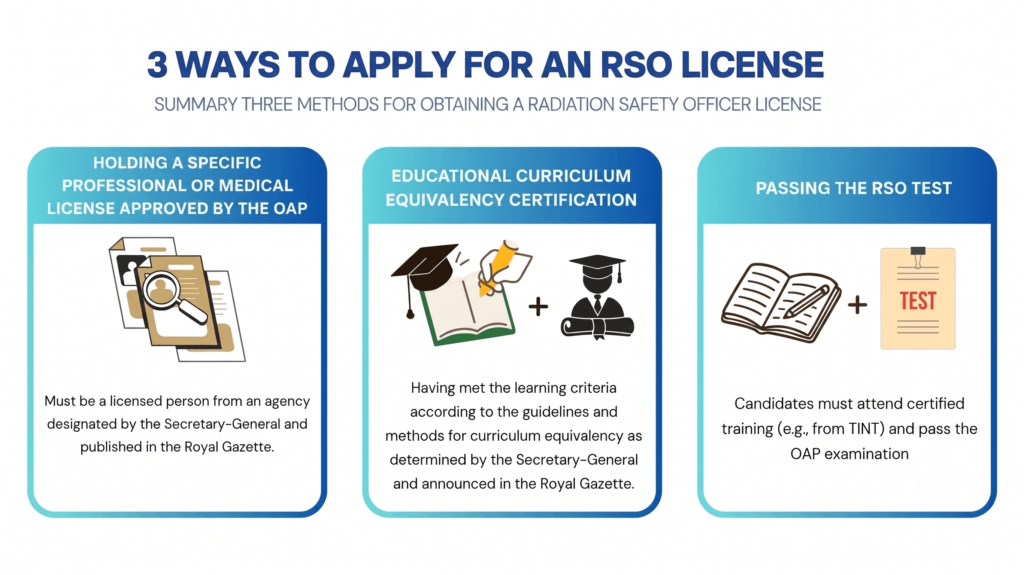
If you meet the requirements for an RSO license, you can apply for one online through the RSO-Thai system. Applicants must submit a license application with the necessary documents, including basic and additional documents depending on the qualifications. There are three main application methods:There are three pathways to licensing:
- Holding a specific professional or medical license approved by the OAP.
- Educational curriculum equivalency certification.
- Passing the RSO Test: Candidates must attend certified training (e.g., from TINT) and pass the OAP examination. For comprehensive application steps, please visit the official OAP RSO Licensing Webpage
Essential Supporting Documents:
To prevent delays, ensure your administrative teams compile and verify the following essential documents before uploading them to the system:
- RSO-01 Application Form
- Copy of ID Card and a formal photograph
- Copy of Educational Certificates/Transcripts
- Proof of Work Experience: Authentic reference letters verifying experience (candidates holding a Vocational Certificate require a minimum of 1 year of verified safety experience).
Acquiring and Renewing Your RSO License
After submitting the documents through the online system, applicants can track processing times on the online portal via the “Check Status” icon. Upon verification, the OAP will issue a physical or digital processing invoice. Following transaction completion, the official physical RSO license is shipped directly to your corporate headquarters.
Every newly issued RSO license remains fully valid for a maximum duration of 5 years. Licensees must submit renewal protocols online in advance before the active license reaches its expiration limit to ensure continuous, uninterrupted compliance.
Summary
Choosing a standard X-ray CT scanner that qualifies for “Notification of Possession” allows you to comply with safety laws easily without the added burden of appointing an RSO. Alternatively, you can still assign a basic level RSO to enhance the capacity of radiation facilities to ensure the safety and health of radiation workers and the general public. If you are unsure about your equipment’s category or need assistance with the notification process, please contact us for expert consultation.
Secure Compliance and Safety with Expert Guidance
If you are preparing to acquire new systems, or require localized support to manage the 30-day notification procedures in Thailand, we are welcome to assist you.
Related Information:
